Senate advances resolution on war powers to stop Trump in Venezuela
On Thursday, the Senate introduced a war powers resolution, which would block the president from using the U.S. military to engage in hostilities in or against Venezuela unless authorized by Congress.
A small group of Senate Republicans joined all Democrats to narrowly advance the resolution with a 52-47 vote. He needed 51 votes to advance.
Republican Senators Rand Paul, Lisa Murkowski, Todd Young, Susan Collins and Josh Hawley voted with all Democrats in favor of the legislation.
Democratic Senator Tim Kaine, a member of the Senate Armed Services Committee, pushed for the resolution to be voted on immediately after President Donald Trump announced that US forces carried out a large-scale attack in Venezuela, capturing dictator Nicolás Maduro and his wife, who face federal charges including narcoterrorism conspiracy and conspiracy to import cocaine.
“Where will this go next? Will the president deploy our troops to protect Iranian protesters? To enforce the fragile ceasefire in Gaza? To fight terrorists in Nigeria? To seize Greenland or the Panama Canal? To crack down on Americans peacefully gathering to protest his policies? Trump has threatened to do all of this and more and sees no need to seek legal authorization from the popularly elected legislature before putting members at risk. of service,” Kaine said in a statement on Jan. 3.
Kaine added that “it is about time for Congress to reaffirm its critical constitutional role in matters of war, peace, diplomacy and commerce.”

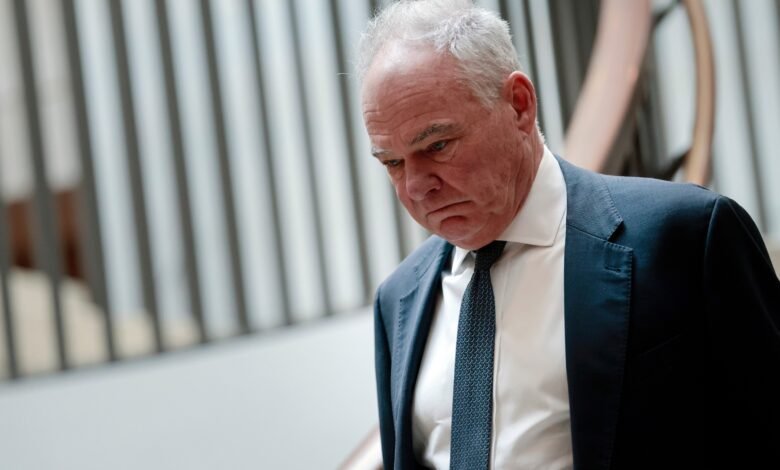
Senator Tim Kaine arrives for a closed-door briefing at the United States Capitol Building on December 17, 2025 in Washington, DC.
Heather Diehl/Getty Images
Senate Minority Leader Chuck Schumer, Republican Senator Paul and Democratic Senator Adam Schiff co-sponsored Kaine’s resolution.
The legislation, if ultimately approved by the Senate, would still need to be approved by the House and signed by the president. The bill did not pass the Senate with a veto-proof majority and Trump appears unlikely to sign it into law.
The Senate considered a similar resolution last November that narrowly failed to get the 50 votes it needed to pass. Senators Paul and Murkowski voted with all Democrats to push for it at the time.
Before Thursday’s vote, many Republicans distanced themselves from the effort.
“Let’s be clear about what that resolution does and does not do. It does not reassert the powers of Congress. It does not strengthen America. It makes America weaker and less secure,” Senate Majority Leader John Barrasso said in a statement Wednesday.
“It would weaken the legitimate constitutional authority of the president. This body, the United States Senate, is asked if the president of the United States has the authority to arrest accused criminals. Of course he does. Democrats want to weaken the president’s ability to enforce the law. That is the wrong message to send to hardened drug dealers and dictators,” Barrasso added.