Judge says documents suggest top Justice Department officials may have pushed to prosecute Kilmar Abrego García after wrongful deportation
A newly unsealed order in the Kilmar Abrego García criminal case reveals that a top Justice Department official called his prosecution “a top priority” shortly after he was wrongly deported. — potentially contradicting the Trump administration’s claims that the decision to prosecute Abrego García was made by local prosecutors, a federal judge said.
After being deported to El Salvador, Abrego García was returned to the United States and charged in Tennessee. on federal human trafficking charges.
Abrego García was released from immigration custody earlier this month and is seeking to have the criminal case dismissed, claiming he is the victim of selective and vindictive prosecution.

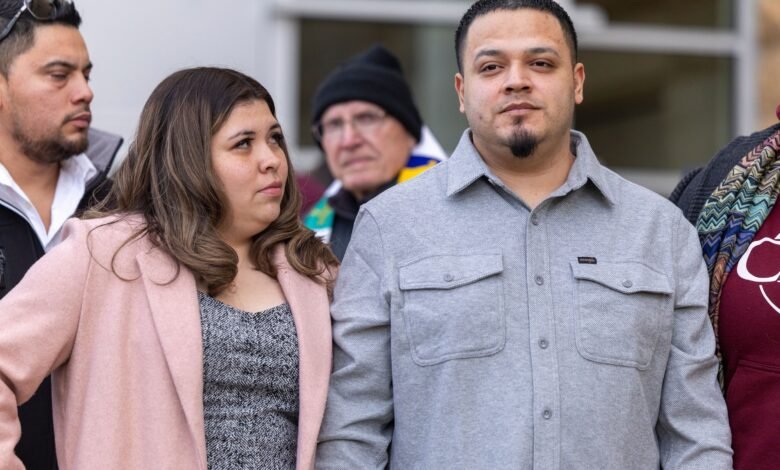
Kilmar Abrego García, with his wife Jennifer Vásquez Sura, leaves after a Temporary Restraining Order hearing in federal court in Greenbelt, Maryland, on December 22, 2025.
Shawn Thew/EPA via Shutterstock
U.S. District Judge Waverly Crenshaw, who is overseeing the Tennessee smuggling case, has scheduled a hearing on the issue next month.
In the unsealed order, Judge Crenshaw said some of the documents presented by the government “suggest” that the Tennessee prosecutor “was not the sole decision maker” in the office’s decision to file human trafficking charges against Abrego Garcia.
The documents, Crenshaw said, show that acting U.S. Attorney Robert McGuire “informed others at the Justice Department and the decision to prosecute Abrego [Garcia] “It may have been a joint decision, with others who may or may not have acted with improper motivation.”
The judge ordered the government to hand over the documents to Abrego García’s lawyers for review.
“The Court recognizes the government’s assertion of privilege, but Abrego’s due process right to non-vengeful prosecution outweighs the general evidentiary privileges asserted by the government,” Judge Crenshaw said.
The federal judge said the documents may contradict the government’s argument that the decision to prosecute Abrego García “was made locally and that there were no outside influences.”

Salvadoran troops guard the exterior of the CECOT (Confinement Center Against Terrorism) where thousands of accused gang members are imprisoned, on December 15, 2025, in Tecoluca, El Salvador.
John Moore/Getty Images
The open order referenced several emails involving Deputy Attorney General Aakash Singh, including one in which the senior Justice Department official “made it clear” that the criminal prosecution of Abrego Garcia was a “top priority” for the department.
The emails were sent in April. — a month after Abrego García, who had been living in Maryland with his wife and children, was deportee to El Salvador’s CECOT megaprison, despite a 2019 court order prohibiting his deportation to that country.
The Trump administration claimed he was a member of the MS-13 criminal gang, which Abrego García denies.
A series of court battles followed, in which the Trump administration repeatedly said it could not bring him back, before the Supreme Court ruled unanimously that the government must facilitate your return.
Abrego García’s lawyers have argued that the government is using the criminal case to punish their client for “successfully fighting his illegal removal.”
Last week, the judge postponed the criminal trial that was scheduled for next month.
Earlier this month, another Maryland federal judge ordered the release of Abrego García from immigration detention, where he had been held since augustand then blocked Immigration and Customs Enforcement to stop it again during the Christmas holidays.