The Senate on Thursday failed to advance two competing health care proposals aimed at addressing rising costs expected for tens of millions of Americans who receive enhanced tax credits from the Affordable Care Act.
Both plans, one proposed by Democrats and the other championed by Republicans, failed to obtain the necessary 60 votes.
The Republicans’ bill failed to advance by a vote of 51 to 48, with Republican Senator Rand Paul the only Republican to vote against it.
The Democrats’ bill also failed to advance by 51 votes in favor and 48 against. Republican Senators Susan Collins, Lisa Murkowski, Dan Sullivan and Josh Hawley crossed the aisle to join all Democrats in supporting him.
Now, lawmakers will only have a few days left to address the expiration of the enhanced tax credits, and there are few signs that any kind of progress is on the horizon.
This is what the plans entailed.
Democratic Plan: Three-Year Extension of Expiring Enhanced Tax Credits
The Democratic plan proposed a three-year extension of enhanced Affordable Care Act subsidies that would otherwise expire on Jan. 1. The enhanced subsidies were originally implemented during the COVID-19 pandemic.
During his floor remarks Wednesday, Minority Leader Chuck Schumer called the Democratic plan “the only realistic path left” to address the impending premium increase.
“We have 21 days until January 1. After that, people’s health care bills will start to skyrocket. Double, triple, even more,” Schumer said. “There is only one way to avoid all of this. The only realistic path left is the one the Democrats are proposing: a clean and direct extension of this urgent tax credit.”

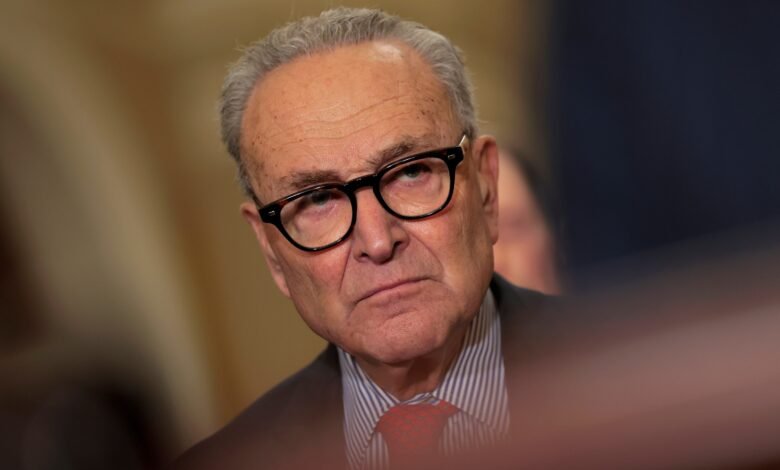
Senate Minority Leader Chuck Schumer speaks to reporters after a Senate Democratic policy luncheon at the U.S. Capitol on December 9, 2025 in Washington.
Heather Diehl/Getty Images
Although Democrats are in the minority, they won a vote on their proposal as part of a deal reached by a small group of Senate moderates to reopen the federal government after a 43-day shutdown, which focused on Democrats’ efforts to address expiring tax credits.
“What we have to do is keep premiums from skyrocketing and only our bill does that when the last train leaves the station,” Schumer said.
But Majority Leader John Thune made clear Wednesday that Republicans would not support the Democratic plan.
Thune called the Democratic proposal an “exercise in partisan messaging” and said Democrats’ claim that their plan would reduce health care costs represented a “tour through fantasy land.”
Republicans have been saying for months that premium subsidies require reform. Without changes, Republicans say, the enhanced subsidies create opportunities for waste, fraud and abuse and have raised the overall cost of premiums.
The nonpartisan Congressional Budget Office estimated that Senate Democrats’ proposal would add nearly $83 billion to the federal deficit over the next decade. The CBO also estimates that enacting the Democratic legislation would increase the number of people with health insurance by 8.5 million by 2029.
Noting the cost of extending the subsidies, Thune said Democrats should present a blueprint that makes changes to the program.
“That’s not what they did… There’s no change,” Thune said. “Just continue to increase the cost. Raising the cost on the individual market like that, but making American taxpayers pay for it and then telling people they’re trying to keep their premiums down,” Thune said. “This does nothing, nothing, to lower the cost of health insurance.”
Republican Plan: Eliminate Enhanced Tax Credits and Create HSAs
Republicans offered an “alternative” plan on the Senate floor Thursday.
The Republican proposal, championed by Senate Health Committee Chairman Bill Cassidy and Senate Finance Committee Chairman Mike Crapo, would eliminate the enhanced tax credits and instead take the extra money from those tax credits and put it into health savings accounts. for those purchasing bronze-level or “catastrophic” plans on the ACA exchanges. Republicans say this will help Americans pay out-of-pocket costs.

Senate Majority Leader John Thune speaks to the media at the U.S. Capitol in Washington, Dec. 9, 2025.
Will Oliver/EPA/Shutterstock
Under the plan, people earning less than 700% of the federal poverty level would receive $1,000 in HSA funds for people ages 18 to 49 and $1,500 for people ages 50 to 64. Republicans say these funds could be used to help cover higher deductibles in lower-cost plans.
Republicans said their plan will reduce premiums through cost-sharing reductions and said the plan will suspend payments to insurance companies. Thune called it “a very different business model” than what Democrats proposed.
“The question is: Do you want the government to decide this or do you want to put this power and these resources in the hands of the American people?” Thune said on the Senate floor Wednesday. “American taxpayers. Patients. That’s what it’s all about.”“
Schumer had called it “dead on arrival.”
“I want to be very clear about what this Republican bill represents: junk insurance,” Schumer said. “Let me tell my Republican colleagues: It’s dead on arrival. The proposal does nothing to reduce sky-high premiums; it doesn’t extend ACA premiums a single day. Instead, Republicans want to send people $80 and pretend that’s going to fix everything.” Schumer said.
Cassidy called Schumer’s categorization of his plan as a “junk plan” “very ironic.”
“These are the Obamacare plans. These are the plans they put in place, except when they made them, they had $6,000 deductibles or $7,500 deductibles. We addressed that deductible. We improved these plans,” Cassidy said. “We Republicans are trying to make it better. We want money in your pocket for your out-of-pocket expenses. [costs]and they want you to be in charge of the whole thing.”
Democrats were also offended by provisions in the Republican bill that prevent funds from being used for abortions. Schumer, on the Senate floor, called it a “poison pill.”
Sen. Patty Murray, the top Democrat on the Senate Appropriations Committee, was asked if she saw any way Democrats could support the bill.
“Not with the choice issues, where they’ve made it so that women can’t access an abortion through their plan,” Murray said. “I don’t see any way this will help people who are being hurt right now by the disappearance of tax credits.”