The Fulton County, Georgia, election interference case against President Donald Trump and others has been dismissed after the prosecutor who took over the case requested that it be dismissed.
“In my professional judgment, it is not in the best interest of the citizens of Georgia to pursue this case in its entirety for another five to ten years,” wrote Pete Skandalakis, executive director of the Georgia Prosecutors Council, who took over the case after the original prosecutor was disqualified from it.
Within minutes of Skandalakis’ court appearance, the judge overseeing the case granted the request and dismissed the case.
“This case is hereby dismissed in its entirety,” wrote Fulton County Judge Scott McAfee, who earlier this month had scheduled a “status/pretrial” hearing in the case for Dec. 1.
Trump and 18 others pleaded not guilty in August 2023 to all positions in a widespread accusation of extortion for alleged efforts to overturn the results of the 2020 presidential election in the state of Georgia.
The charges, which were filed by Fulton County District Attorney Fani Willis following Trump’s Jan. 2, 2021, phone call in which he asked Georgia Secretary of State Brad Raffensperger to “find” the votes necessary to win the state, they allege that the defendants solicited state leaders across the country, harassed and deceived a Georgia poll worker, and pushed false claims that the election was stolen, all in an effort to keep Trump in power despite his election loss.
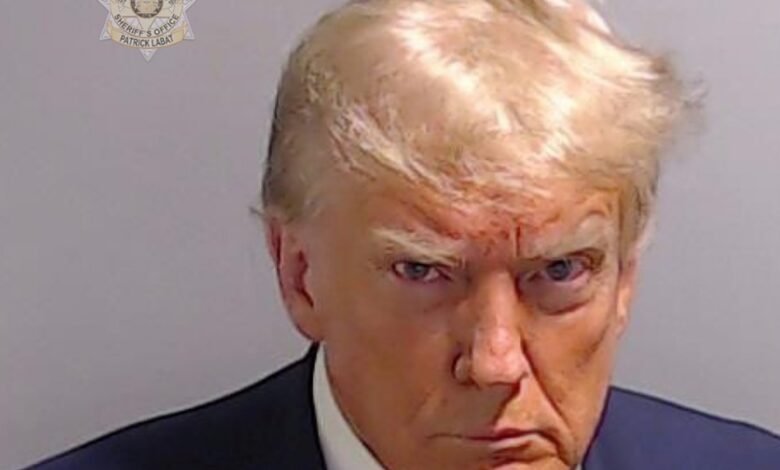
Trump and the other defendants handed over to the authorities at the Fulton County Jail in Atlanta, where Trump was held released on $200,000 bail after mugshot taken for the first time for an ex President of the United States.

Former President Donald Trump poses for his booking photo at the Fulton County Jail on August 24, 2023 in Atlanta, Georgia.
Fulton County Sheriff’s Office via Getty Images
Defendants Sidney Powell, Jenna Ellis, Kenneth Chesebro and Scott Hall later took plea deals in exchange for agreeing to testify against other defendants.
Willis was later disqualified from the case following allegations of wrongdoing in connection with his relationship with a fellow prosecutor, leaving a Georgia bar council to assign an independent prosecutor to take charge of the case and determine its fate.
Skandalakis took on the case himself earlier this month after saying he was “unable” to find anyone else to take the job.
In a statement following the case’s dismissal, Trump attorney Steve Sadow said: “The political persecution of President Trump by disqualified District Attorney Fani Willis is finally over. This case should never have been brought. A fair and impartial prosecutor has put an end to this legal war.”
A spokesperson for former New York City Mayor Rudy Giuliani, who was banned from practicing law in New York and the District of Columbia for his efforts related to the 2020 election, praised the firing.
“The decision to dismiss all criminal charges against Mayor Rudy Giuliani is long overdue and represents a complete repudiation of the demonstrably false claims that partisan actors used to justify his improper disqualification,” Giuliani spokesman Ted Goodman said in a statement.

Rudolph Giuliani, President Donald Trump’s attorney, leads a press conference at the Republican National Committee on lawsuits related to the outcome of the 2020 presidential election, Nov. 19, 2020.
Tom Williams/CQ-Roll Call via Getty Images
Wednesday’s dismissal marks the end of the two major election interference cases Trump faced after the 2020 election.
Following an eight-month investigation by then-special prosecutor Jack Smith, Trump pleaded not guilty in August 2023 on charges of undertaking a “criminal scheme” to overturn the results of the 2020 election by recruiting a list of so-called “fake electors,” using the Department of Justice to conduct “false election crime investigations,” trying to recruit the vice president to “alter election results,” and promoting false claims of a stolen election as the Jan. 6 riots erupted.
After Trump was re-elected president last year, the case became dismissed without prejudice due to the Justice Department’s long-standing policy prohibiting the prosecution of a sitting president.
In a 22-page document explaining his decision to drop the Fulton County case, Skandalakis wrote that the allegations and theory of the case “are not a viable basis for prosecution,” and noted the timing and logistical difficulties in pursuing the case specifically against Trump.
He acknowledged the seriousness of the case and wrote that the allegation, if proven, would “establish a conspiracy undertaken by multiple individuals… to overturn the results of the November 2020 presidential election,” but said it would not be feasible to pursue a criminal case against Trump.
“There is no realistic prospect that a sitting president will be forced to appear in Georgia to stand trial for the allegations contained in this indictment,” he wrote. “And even if, due to some extraordinary circumstance, [Trump] “If he were to appear in Georgia on January 21, 2029, the day after his term ends, an immediate jury trial would be impossible.”
As for the details of the case against Trump, Skandalakis wrote that “overt acts such as arranging a phone call, issuing a public statement, tweeting to the public to watch the Georgia Senate subcommittee hearings, texting someone to attend those hearings, or answering a 63-minute phone call without providing the context of that conversation, just to name a few examples, are not acts I would consider sufficient to sustain a RICO case,” referring to the racketeering charges he faced. Trump.
Skandalakis wrote that he considered separating Trump from his co-defendants, but concluded that such a move would be “futile and unproductive.”
He also concluded that the case should have been heard at the federal level, not in a Fulton County court.
“The criminal conduct alleged in the Atlanta Judicial Circuit prosecution was conceived in Washington, DC, not the state of Georgia. The federal government is the appropriate venue for this prosecution, not the state of Georgia,” he wrote.
Skandalakis also described what he identified as flaws in the prosecution’s theory of the case, including that the accused Republican electors lacked criminal intent and that the allegations against Trump’s former chief of staff, Mark Meadows, and former Justice Department official Jeffrey Clark, “fall short of the much more rigorous standard of proof, beyond a reasonable doubt, required to support a criminal conviction.”
Concluding his explanation, Skandalakis acknowledged that his decision would receive pushback, but said he still had to make it.
“The role of a prosecutor is not to satisfy public opinion or achieve universal approval; such a goal is unattainable and irrelevant to the proper exercise of prosecutorial discretion. My evaluation of this case has been guided solely by the evidence, the law, and the principles of justice,” he wrote.
ABC News’ Aaron Katersky contributed to this report.