17 House Republicans vote with Democrats to extend Obamacare subsidies for 3 years
The House on Thursday approved a bill to extend the Affordable Care Act’s enhanced subsidies for three years by a vote of 230 to 196, with 17 Republicans voting with Democrats and defying GOP leaders.
Before the vote, Democrats boasted that several Republicans were expected to challenge their leadership team.
A tangible path forward that sends legislation through the Senate to the Resolute Desk to address expired subsidies remains questionable.
Senate Majority Leader John Thune said Thursday there is “no appetite” for an extension in the upper chamber, instead pointing to ongoing bipartisan talks between senators and House members.
“As you know, we’ve already had that vote,” Thune said. “But we’ll see what happens from the working group and if they can propose something that includes reforms. And we’ll go from there.”
House Minority Leader Hakeem Jeffries expressed pride in the “bipartisan coalition” created ahead of Thursday’s vote on a three-year extension of the Affordable Care Act’s enhanced subsidies after nine Republicans crossed the hallway Wednesday night to prepare for passage in the House.
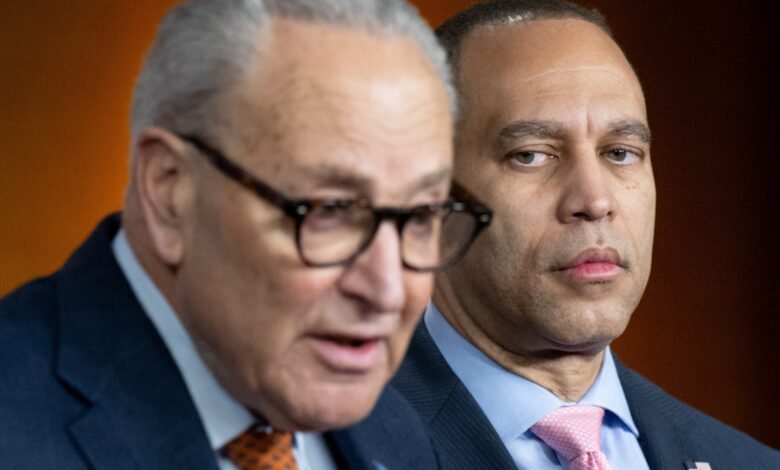
“I hope there are more Republicans today who will rally behind this leader,” Senate Minority Leader Chuck Schumer said, pointing to Jeffries at a news conference Thursday.
Jeffries called the vote “an opportunity to take a significant step forward in reducing the high cost of living for ordinary Americans, particularly when it comes to health care, but it is a battle we will continue to fight on behalf of the American people.”
Wednesday’s procedural vote passed by a margin of 221 to 205, with nine Republicans voting alongside Democrats to approve it.

Senate Minority Leader Chuck Schumer and U.S. House Minority Leader Hakeem Jeffries hold a news conference at the Capitol in Washington, January 8, 2026.
Saúl Loeb/AFP via Getty Images
The subsidies, which expired at the end of 2025, were enhanced during the COVID-19 pandemic to increase the amount of financial assistance to those already eligible and expand eligibility to more people.
A bipartisan group of House members and senators met for about an hour over lunch Thursday to discuss several health care provisions, and later told reporters they had reached an agreement to address widespread fraud, such as ghost accounts.
“We’re trying to see if we can come to some agreement that will help them, and the sooner we can do it, the better,” New Hampshire Democratic Sen. Jeanne Shaheen told reporters as she left the meeting. “So there was agreement to address the fraud.”
Shaheen did not divulge details of an imminent agreement, but said the next step will be to draft the text of the bill in the coming days.
Many conservatives want to add Hyde Amendment protections to ensure that an extension of ACA tax credits does not provide federal funding for abortion services, fueling Democratic opposition to GOP proposals.
But several moderates, including Reps. Don Bacon and Dan Meuser, admitted that the ACA already includes Hyde protections, so there’s an ongoing debate among appropriators about whether that’s enough coverage for conservatives if an extension of subsidies doesn’t explicitly codify those protections.
However, some Republicans believe a bipartisan agreement is possible.
“Things are still being discussed. There are always the details: the so-called devil in the details, or perhaps the angel in the details,” Meuser said, adding that lawmakers hope to conclude discussions “as soon as possible.”
“I mean, it’s certainly a sense of urgency, to say the least,” he said.
Lawmakers did not reveal whether they scheduled another meeting, but noted that the text of the bill could be ready soon.
“They’re very close,” said Republican Rep. Brian Fitzpatrick, adding that the bill mirrors language in a bill he, Lawler and Democratic Reps. Tom Suozzi and Jared Golden introduced.
Suozzi said it was “a very hopeful feeling when you participate in a meeting like this,” citing an even split between Democrats and Republicans at the meeting, while emphasizing everyone’s commitment to “get beyond this toxicity and try to find common ground.”
Last month, the Senate rejected a three-year extension of the subsidies when the measure failed to meet the 60-vote threshold, although four Republicans — Sens. Susan Collins of Maine, Josh Hawley of Missouri, and Lisa Murkowski and Dan Sullivan of Alaska — crossed the aisle to support the measure.
An estimated 22 million of the 24 million ACA marketplace enrollees currently receive enhanced tax credits to reduce their monthly premiums, and many will see their premiums skyrocket in 2026.

Senate Majority Leader John Thune speaks during the Senate Republican Political Luncheon press conference on Capitol Hill, January 6, 2026, in Washington.
Rod Lamkey/AP
The nonpartisan Congressional Budget Office estimates the bill would increase the federal deficit by about $80.6 billion over the next decade.
If the measure is enacted, the number of people with health insurance would increase by 100,000 people in 2026, 3 million in 2027, 4 million in 2028 and 1.1 million in 2029, relative to current law, the CBO reported.
According to the CBO, the 4 million increase in 2028 would result from changes to several types of coverage: 6.2 million more people would enroll through the ACA health insurance marketplaces; 400 billion more people enrolled in Medicaid and the Children’s Health Insurance Program; 500,000 fewer people would purchase non-group coverage outside the exchanges; and 2.1 million fewer people would have employment-based coverage.
President Donald Trump has publicly expressed his opposition to extending the enhanced subsidies.
“I wish we couldn’t do it. I’d like to see us jump right into this. I don’t know why we have to extend it; this can be done quickly if the Democrats would come together,” Trump said Dec. 18 in the Oval Office.
After Speaker Mike Johnson resisted pressure to allow a vote on subsidies late last year, a quartet of House Republicans (Fitzpatrick, Lawler, Bresnahan and Mackenzie) banded together before the holidays and signed a Democratic discharge petition to force a vote on an ACA extension, much to the chagrin of Republican leaders.
ABC News’ Allison Pecorin contributed to this report.